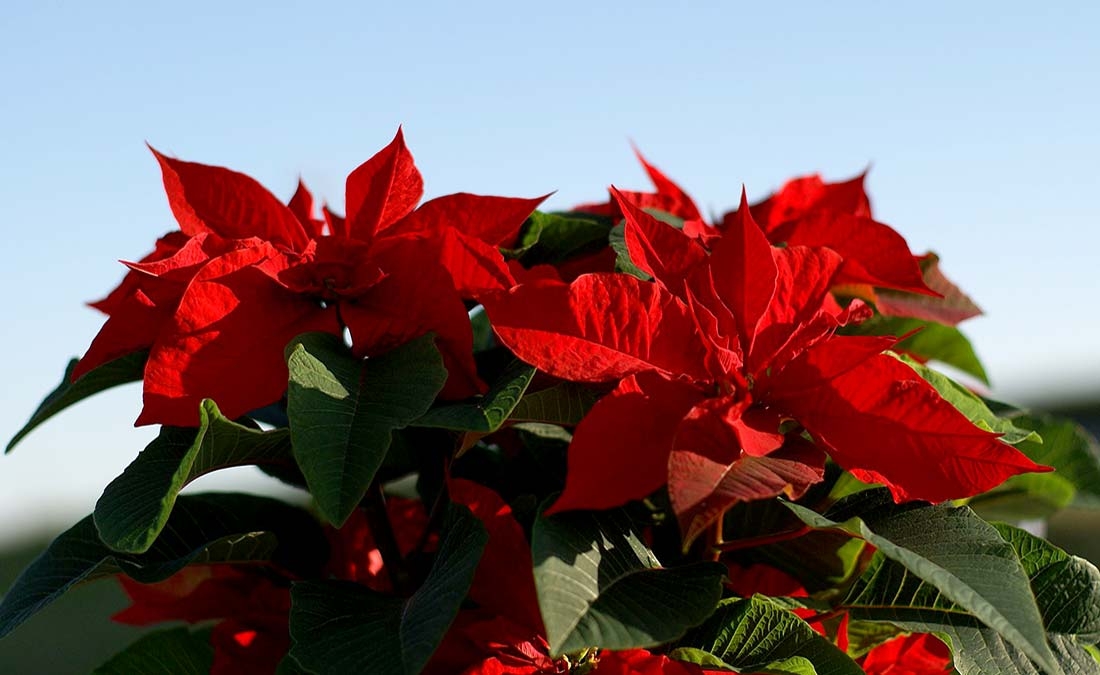
The Poinsettia (Euphorbia pulcherrima), also known as the Star of Bethlehem, is maybe the most popular plant of the holiday season, rightfully called the Christmas flower!
Originally from Central America and more specifically Mexico, it brings warmth and decorates our houses with its intensely red color, adding its own special flair to the festivities!
According to an Aztec myth, its red color comes from a heartbroken goddesses’ blood! It is also said that Montezuma, the last Aztec king, demanded to have blossomed Poinsettias brought to the cold Mexican highlands from the tropical forests where they grew during the short winter days…
The truth is the Aztecs particularly appreciated the plant, notably because its leaves produced a red paint used for fabrics and jewelry.
Another sweet, fairytale-like story talks about two young siblings, who, on their way to church on Christmas day, were feeling sad because, while they wanted to get something special for newborn Jesus, all they could afford was a small bouquet of weeds that they gathered from the side of the road. They were ashamed of the roughly put together bunch of weeds and the insignificance of their offering and had tears in their eyes while entering the village’s chapel… It seems though that even the humblest of offerings is welcomed when it’s heartfelt, since as soon as they left their bouquet upon the image depicting the birth of Christ, the weeds were transformed into shiny red flowers, the ‘Flowers of the Holy Night’, that flourish during the Christmas season ever since.
Today, the flower is commonly called Poinsettia, named after the first ambassador of the United States to Mexico, Joel Poinsett, a botanist and doctor who, impressed by the red flowers growing on the side of the roads, sent cuttings back to his country in 1828. Thus began its long journey and spread around the globe.
Thanks to its red and impressive flower in the middle of winter, the beautiful plant became highly sought-after over time.
The Poinsettia is suitable for interior spaces, has thick foliage and large bracts, mainly red, but also found in white, pink and yellow colors. In the middle of the bracts’ rosette there are tiny yellow flowers. Its height starts off from 15 centimeters and can easily surpass a meter under the proper conditions. Imagine that we’ve found Poinsettias in house yards in Peloponnese or Crete that are more than 3 meters tall!
This year also it is quite likely that you will be offered a Poinsettia for Christmas…
All along the flowering period it should be placed in a well-lit location. It is afraid of air currents and sudden temperature changes. It needs water regularly, in small doses. If you observe that the Poinsettia’s flowers start to turn yellow, twist and then fall off, you should move it to a better location and irrigate it less frequently.
However, even if it loses all its leaves, don’t throw it away!
The Poinsettia is a perennial plant that can live and flourish for many years when properly taken care of. Therefore, after the flowering period is over, prune the plant leaving 2-3 buds on each branch. This will help to make it stronger. It would be best to use gloves for pruning because the shoots contain a milky juice which is believed to be poisonous. I personally think it only causes itching… In any case, the Aztecs used it to make a remedy for fever treatment! In early spring the Poinsettia can be moved outdoors and doesn’t need water more than once a week.
When you see the first buds of the plant ‘swell’, it means the time has come for transplantation to a more spacious flowerpot. Always be careful not to disturb the roots more than necessary and make sure that the soil is well-drained; it is a necessary condition to ensure the plant’s health and longevity. After the transplantation, irrigations should be more frequent and fertilization should occur every 20 days, using a liquid fertilizer that is rich in potassium.
In the summer time, the Poinsettia will turn into a fully green bush that likes light but shouldn’t be directly exposed to the sun’s rays.
Remember to regularly check your plant for diseases and spray it with a biological product if necessary.
From that point on, your Poinsettia is an outdoor plant that will make it worth your while thanks to its thick foliage. It will grow red bracts once more, although they won’t be as big and as red. And, most importantly, the flowering will be somewhat… untimely, around March.
If that’s disappointing for you and you definitely want a red Christmas star on time, there is a trick!
You will have to keep the ‘poor’ Poinsettia in absolute darkness for 15 hours a day during October and November, 2 months ahead of Christmas…
I propose to let nature take its course and have the Poinsettia flower in the springtime at its own pace. In any case, it is not that simple and easy to apply the techniques used by plant nurseries to achieve flowering right on cue for Christmas.
Not only that, but surely someone will get you a new red Christmas flower again this year…
" Merry Christmas! "