By Niki N. Kefala
Agriculturist
niki.kefala@greenfox.gr
If we were to paint a picture of contemporary Athens, we would be using more grey and less green. In a cemented city, with smog shrouding us, the smoldering asphalt, soaring temperatures and noise piercing our ears, the few parks left probably aren’t enough to save us… The same goes for all densely populated Greek cities…
Green roofs or roof gardens, popular in many European countries, have shown significant environmental and ecological benefits. They seem to be a good way to enhance the environment so as to give inhabitants of major cities a breath of life.
DEFINITION
A green roof is a garden that entirely or partially covers the roof of a building. Interventions based on science and vegetation management are carried out on green roofs in order to:
- Enhance the environment
- Increase the energy efficiency of buildings
- Reduce energy consumption
TYPES
Depending on the use, vegetation, thickness of the substrate upon which plants grow and manufacturing process, green roofs are divided into three types:
1) Extensive green roofs
Extensive green roofs consist of an infrastructure system and a special, light substrate, for vegetation that grows 7-15 cm high, which, along with the plant material, create an ecosystem that needs little maintenance. The saturated weight should be between 70-120 kg/m2. The plants that are used are shallow-rooted. The construction’s limited weight allows for it to be installed on any roof with an inclination of 45 degrees. If the slope is over 20 degrees, it is essential to use geocells or other soil retention systems. Plant options for this type of green roof include low vegetation, turfs and ground covering plants.
2) Semi-intensive green roofs
Semi-intensive green roofs consist of an infrastructure system and a light substrate for plants expected to grow 12 – 40 cm. Saturated weight ranges between 120 and 250 kg/m2. They are installed upon inclined or flat roofs and require moderate maintenance (occasional irrigation, fertilization, etc.). Vegetation options include herbaceous plants, ground covers, and small/medium-sized shrubs.
3) Intensive green roofs
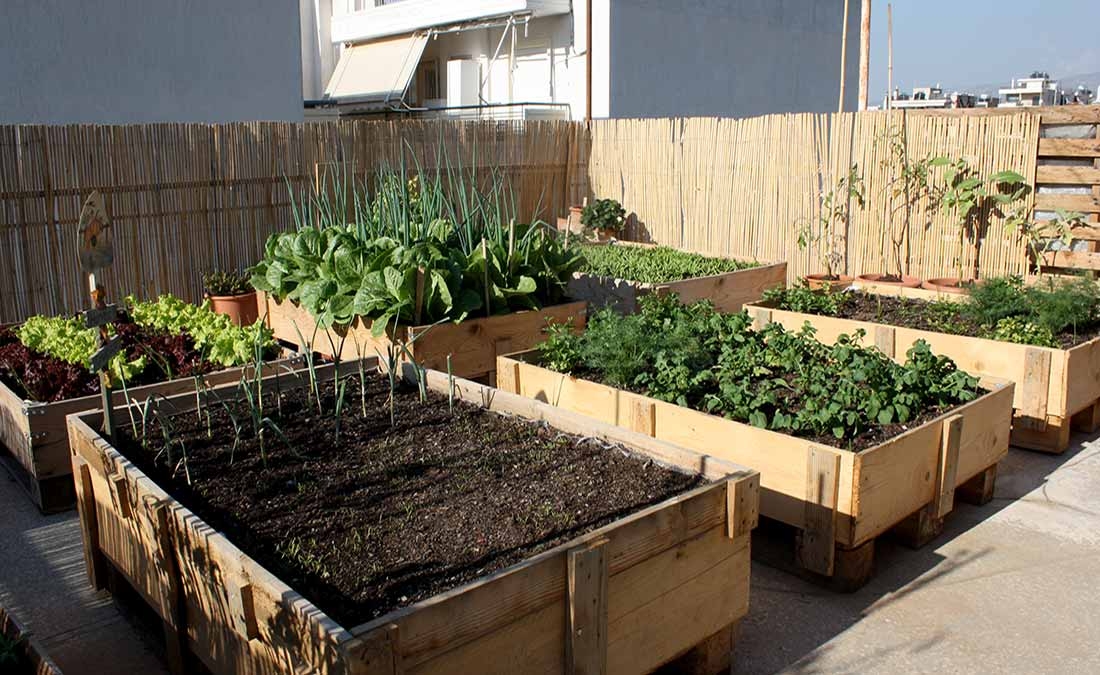
Intensive green roofs consist of an infrastructure system and a light substrate for plants that grow 15-150 cm high. Saturated weight is at least 250 kg/m2. This type of roof garden requires regular maintenance (irrigation, fertilization, etc.). It is characterized by its variety of plants, small trees and shrubs, as well as by its ability to accommodate installations such as walkways and water features.
In the future we will analyze the manner of construction as well as the economic and ecological benefits of installing a roof garden.
Tip:
We cannot rebuild our city from scratch, but we can make it greener!