By Niki N. Kefala
Agriculturist
niki.kefala@greenfox.gr
Mediterranean gardens are defined as smaller ‘pieces’ of the Mediterranean landscape that are in harmony with the lines, colors and texture of the environment.
They fall into two basic categories: Firstly, gardens found in southwest Europe (Granada, Seville), which have borrowed elements from Islamic gardens and are centered around the water/life-giving element. Secondly, gardens with formalistic influences which developed in south Europe (France, Italy) during the Renaissance era and have inherited the imperial grandeur of the times. Today, most Mediterranean gardens combine elements from both periods but move towards a freer, more natural formation, based on the cultivation of xerophytes that require little irrigation and maintenance.
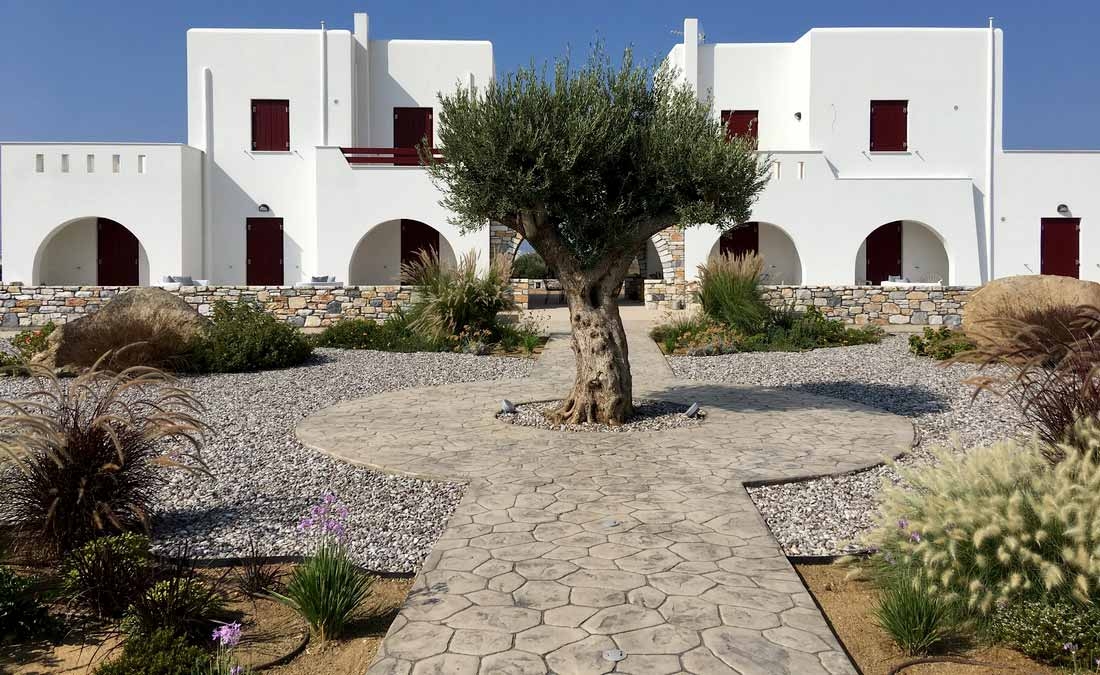
One characteristic of the Mediterranean Garden is the inner courtyard, which also serves as a semi-open-air space, offering peace of mind and shade. It is one of the main elements of the Mediterranean garden. Other characteristics are the pavements, colored gravel or beaten earth walkways, as well as agricultural terraces for olive trees, fruit trees, vines and vegetables. Evergreens, such as cypresses, olive trees, strawberry trees, myrtles, laurel trees, pistacias, rosemary, lavender, oregano and sage are all frequently planted, either in clusters or individually.
The planning possibilities for such garden are endless. You may proceed to design a garden with an emphasis on easy and resilient plants, lightweight constructions (walkways, gazebos, stone walls and pavements) made from natural materials (wood, stone, pebble, gravel), and discreet lighting, taking the following variables into account:
- The already existing plants, which must be maintained and highlighted (a century-old olive tree or a pine tree for example), depending on their age,
- the area’s climatic conditions (amount of sunshine, wind) and the landscape’s special conditions (soil quality, slope etc.),
- the irrigation possibilities and
- the time availability.
You are advised to go for similar colors and plant types so as to achieve a uniform and elegant result. Land coverage, wherever necessary, should be achieved via creeping plants (rosemary, lantana). To combine the beautiful with the beneficial, consider planting fruit-bearing trees and aromatic plants. Lastly, save some space for a vegetable and fruit garden.
It takes only a few simple steps to create your own paradise, where the constant alternation between light and shade, the sound of the water, the winged visitors, the colors, and the unparalleled scents will keep all five of your senses alert yet tension-free, revealing secrets from another world…
Tip:
In a Mediterranean garden that respects itself and water as a precious resource, there is no place for high-quality turfs.