
By Niki N. Kefala
Agriculturist
niki.kefala@greenfox.gr
Zen gardens are shrouded in wonderful mystery… Western mentality makes it difficult to understand Buddhist philosophy and even harder to apply it in nature as an act of meditation, rather than mere gardening.
The purpose of Zen teaching is to discover our own nature, to acquire deep insight into ourselves and to surpass the limits of cognition so as to achieve serenity. The Japanese, who are considered to be its main representatives, allow the order of the plants or the precise space between rocks and trees to bear witness to the simplicity and clarity of expression. Knowing what needs to be left out and how to handle void and silence, they create a garden that reflects nature in its purest form.
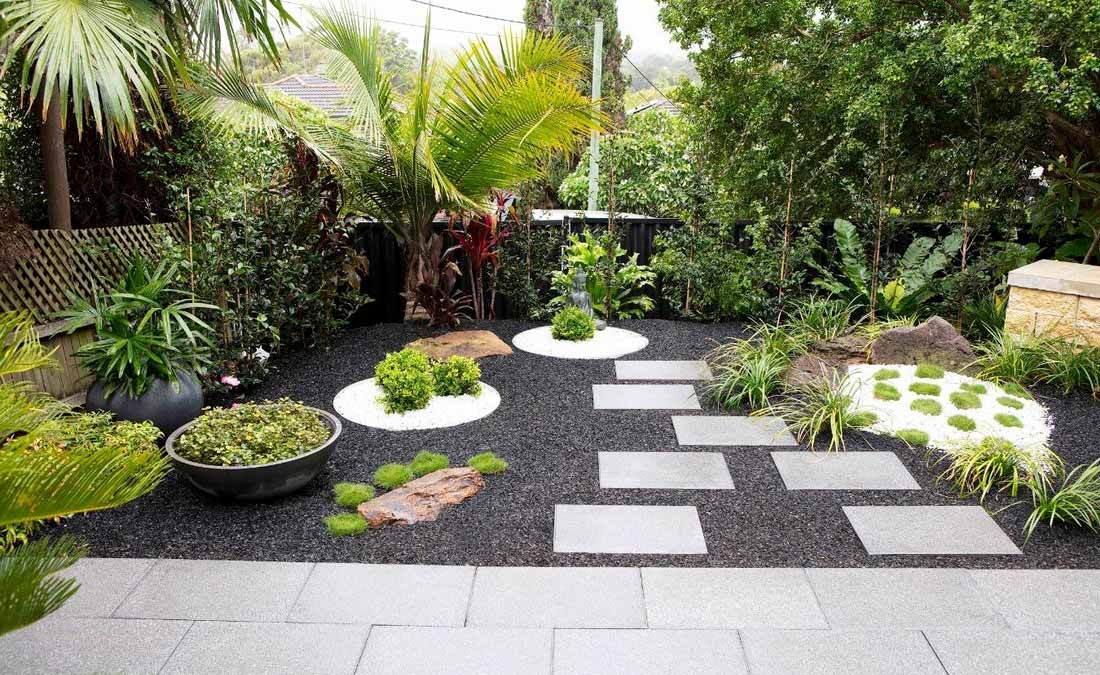
A Zen garden is a miniature model of the natural landscape. Its design as well as its maintenance constitute part of a process of meditation. In Japanese landscape architecture nothing is random! On the contrary, everything is the function of careful study whose ultimate aim is total harmony. That is why a Zen garden design is intrinsically linked to the design of the house, as it needs to be visible from the inside allowing nature and light to penetrate through large openings.
If we were to walk in a Zen garden, forgetting the perfectly structured and symmetrical European gardens, we would be surrounded by nature’s harmonic asymmetry and become lost in time and space. Invisible lines and curves follow the natural elements, with the requisite running water evocating the passage of time, while the rocks positioned alongside it symbolize important aspects of life’s journey. The gravel and sand are “brushed” with rakes in order to mimic water flow. Tiny bonsai trees, ferns, moss, black pines, and beeches signify nature’s permanency. Small plants in earth tones or sharply contrasting colors allude to the cycle of the four seasons and illustrate different moods. Bamboos are used as a fence, a “friendly” frontier with the outside world. Ornaments made of metal, discreetly placed among the foliage, complete the picture, highlighting nature as the ultimate work of art.
In this way, the garden is transformed into a place of serenity and contemplation, magnetizing and luring the visitor away from the world’s noise, aiming to revitalize him spiritually and psychologically. Thus it will no longer be difficult for one to encounter the faeries that accompanied him as a child…or are they still accompanying him?
Tip:
Zen gardens are recognized as neuropsychological tools to study brain functions. Definitely not a coincidence!