The main characteristics of summertime in Greece include intense sunlight, high temperatures and hot winds. These constitute difficult weather conditions for the greenery, which is threatened by drought on the islands and the South of the country.
Additionally, freshwater resources are constantly decreasing and even if we were willing to bear the economic cost of its consumption, this essential natural resource requires protection and an integrated management plan so as to avoid its depletion.
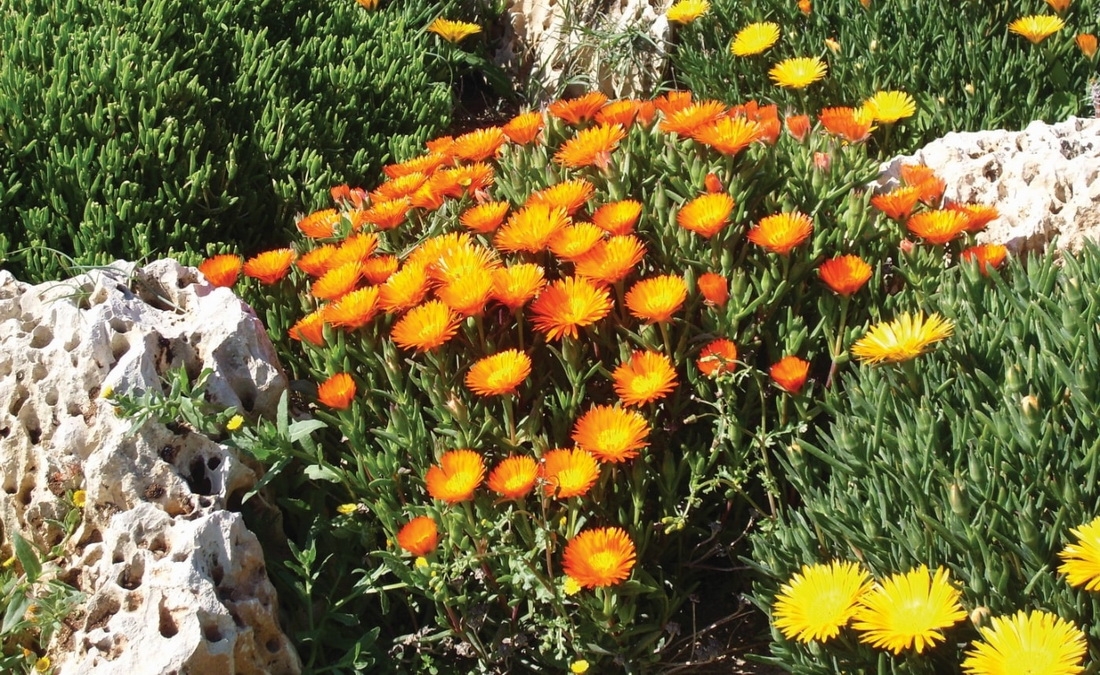
In light of this threat, the concept of the Waterless Garden would constitute an innovative solution of gardening with reduced or even zero water needs. It is perfectly balanced with the environment as an inseparable part of the Mediterranean scenery, ready to gradually spread under the merciless sun. It shows excellent ability to adapt while offering rich colors, sounds and scents!


Starting with the design of the Waterless Garden, we emphasize the importance of the site orientation, the morphology and the soil consistency, the area’s microclimate, the proper plant selection, the land cover of the unplanted surfaces and, of course, the installation of a proper irrigation system that will ensure water conservation as well as plant growth.
Looking for drought-resistant plants of the Greek flora in nurseries, you will be pleasantly surprised by the wide variety of trees, shrubs, bulbs, aromatic and seasonal plants which are cultivated mainly in Greece! These plants, forgotten or substituted by foreign species over the years, are now making a comeback!
You will be impressed by the survival mechanisms these plants have developed to cope with the long periods of summer drought. You will be able to observe that sometimes they remain hidden in the ground waiting for the autumn rains, or they drop their leaves to reduce their transpiration, or they use the silver lint of their leaves to retain the moisture and reflect the sunlight. They can also elicit ethereal oils to reduce their leave temperature and so on… there is no end to their ingenuity! Meanwhile, regardless of the stage of their life, they will remain attractive, even during their summer dorm, decorating the landscape in a subtle, natural way, as they only know how…
Among them you will find…
- succulents with fleshy leaves such as Agave americana, Aloe vera, Ficus opulus and Euphoria sp.
- aromatics with grey fuzz such as Lavandula officinalis, Helichrisum sp., Salvia officinalis and Origanum dictamus
- drought resistant bushes like Spartium junceum, Pistacia lenticus, Cistus creticus, Phlomis fruticosa and Elaegnus x ebbigne
- ornamental weeds like Stipa sp. and Miscanthus sin.
- trees such as Olea europaea, Elaeagnus angustifolia, Punica granatum, Acacia cyanofylla, Cercis siliquastrum
For even more color and scent the following species are also suggested: Myrthus communis, Vitex agnus castus, Lonicera japonica, Santolina chamaecyparisus, Verbena x hybrida, Pelargonium odoratissimum, Rosmarinus officinalis, Origanum vulgare, Thymus vulgaris, Bougainvillea x buttiana, Nerium oleander.
Before you decide which species you would like to plant, take into consideration the lowest temperature of your area, since many drought-resistant plants are sensitive to frostbite. It is not recommended that you install a lawn in the Waterless Garden, but if green coverage is absolutely necessary then you could choose some ground crawling plants.
Besides a proper design and a suitable plant selection, the Waterless Garden needs simple but systematic cultivation techniques that will allow it not only to survive but also to thrive in the long run.
In order to achieve a sustainable result, your planting should take place during the autumn months in order to take advantage of the winter rains. Don’t hesitate to choose smaller plants since they are more adaptable. Before planting, soil scraping and the incorporation of river sand, gravel or pumice stone are recommended to ensure the drainage of your garden. Covering the non-planted areas with organic materials (pine bark, dry twigs etc.) or inorganic ones (pebbles, gravel etc.) will reduce the surface water evaporation, inhibit aggressive weeds and give a beautiful aesthetic result to your construction.
The Waterless Garden will require “deep” watering about twice a month, during its initial installation and maybe during the first summers. Infrequent watering with large amounts of water, will force the roots to penetrate deeper into the soil and grow more resistant to drought. For this reason, you should dig large basins around the plants (individual or in groups) fill them with water and let the plants drink it slowly… Depending on the plant species, the consistency of the soil and the orientation of the garden, you will gradually space out the watering until your plants are “toughened” enough for the drought.
We hope to have aroused your interest, given you food for thought and brought you a little closer to this particular kind of garden…
In modern gardening the Waterless Garden is a proposal of a surprisingly simple structure.
Modest and humble, without exaggeration and needless pomposity, it lives a simple life while it generously spreads its environmental benefits.
The most beautiful example of a Waterless Garden on a large scale can be seen everywhere on the Cyclades … you will surely have wondered how life is possible on a rock under the hot sun … nature has the answer!
In conclusion, we need to point out that through the process of creating a Waterless Mediterranean Garden, we demonstrate our respect for the environment, we reproduce the Greek nature, we strengthen the production and trade of local flora, and finally we sustainably use freshwater with wisdom and gratitude, so that we can continue to enjoy the benefits of its presence with no expiration date!
Let mother nature teach us about balance and harmony, modesty and economy … it’s time to reach out to her and follow in her footsteps!
By Niki K. Kefala
Agriculturist
niki.kefala@greenfox.gr